 Develupp
iPhone 12 Pro or later (Pro models)
Camera scan
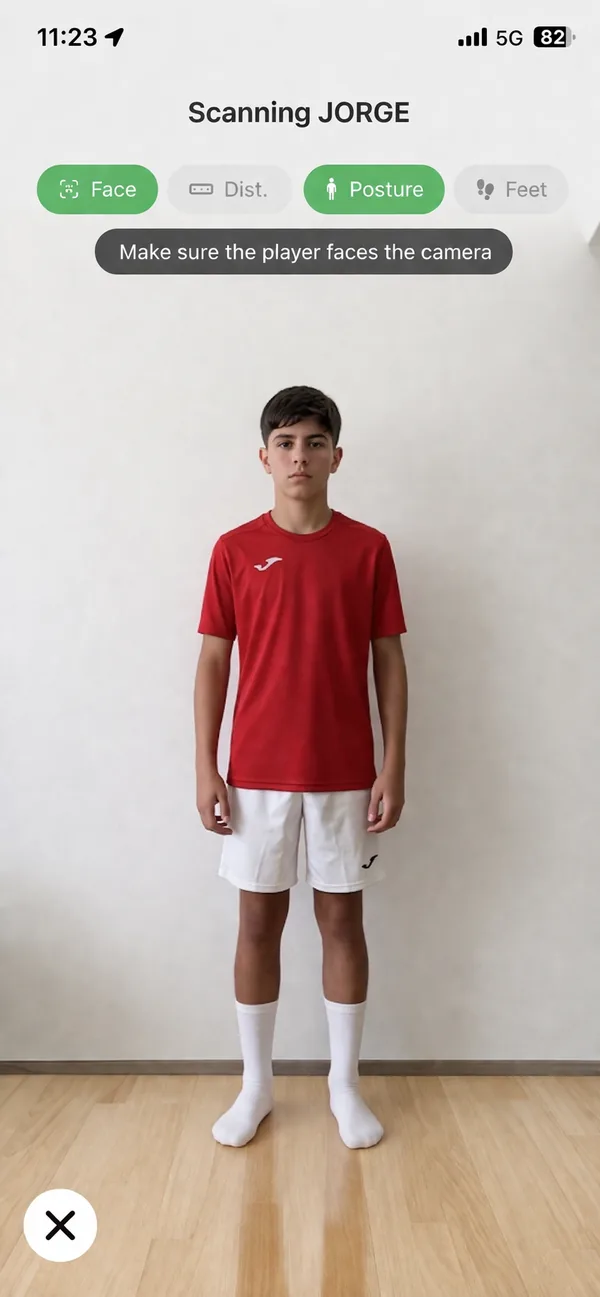
The app checks face, distance, posture and feet to help staff follow a consistent measurement process.
- Standing height
- Sitting height
Growth & maturation for youth sport
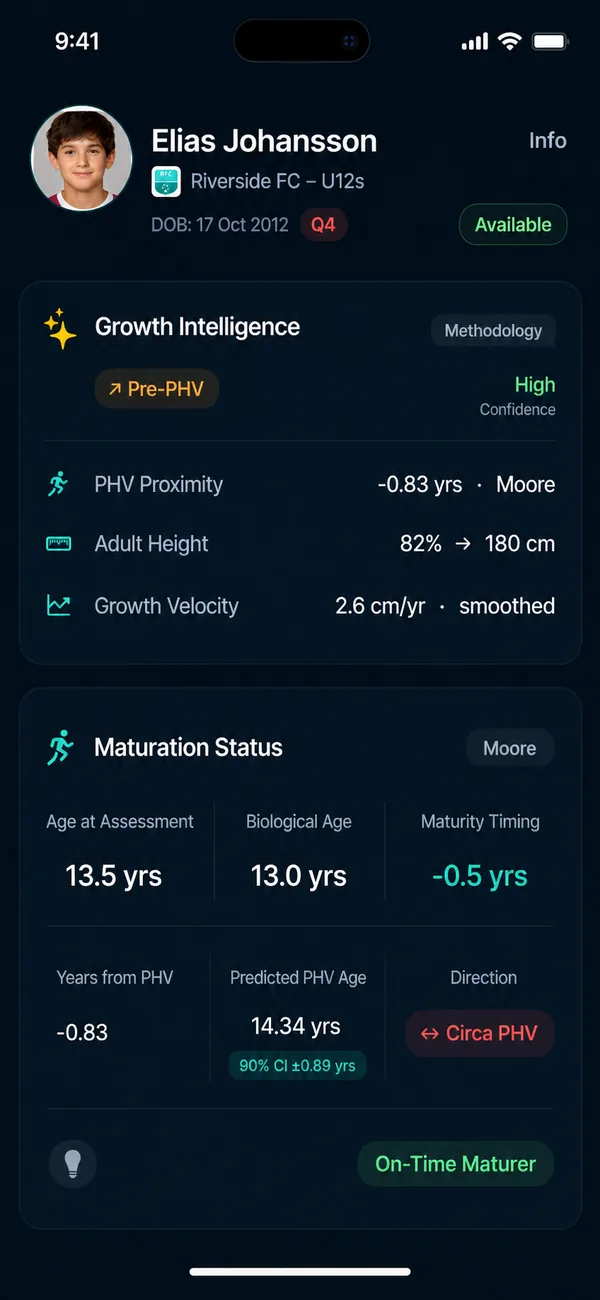
Growth and maturity estimates from published methods, updated every time you measure. Better-informed youth-sport decisions, all in one iPhone app.
The problem
Problem 1
Two players born the same month can sit years apart in physical maturity and still be in the same age group.
Cumming et al., 2017Problem 2
Bigger, faster and stronger today looks like more talent, so late developers are easy to release before they catch up.
Cumming et al., 2017Problem 3
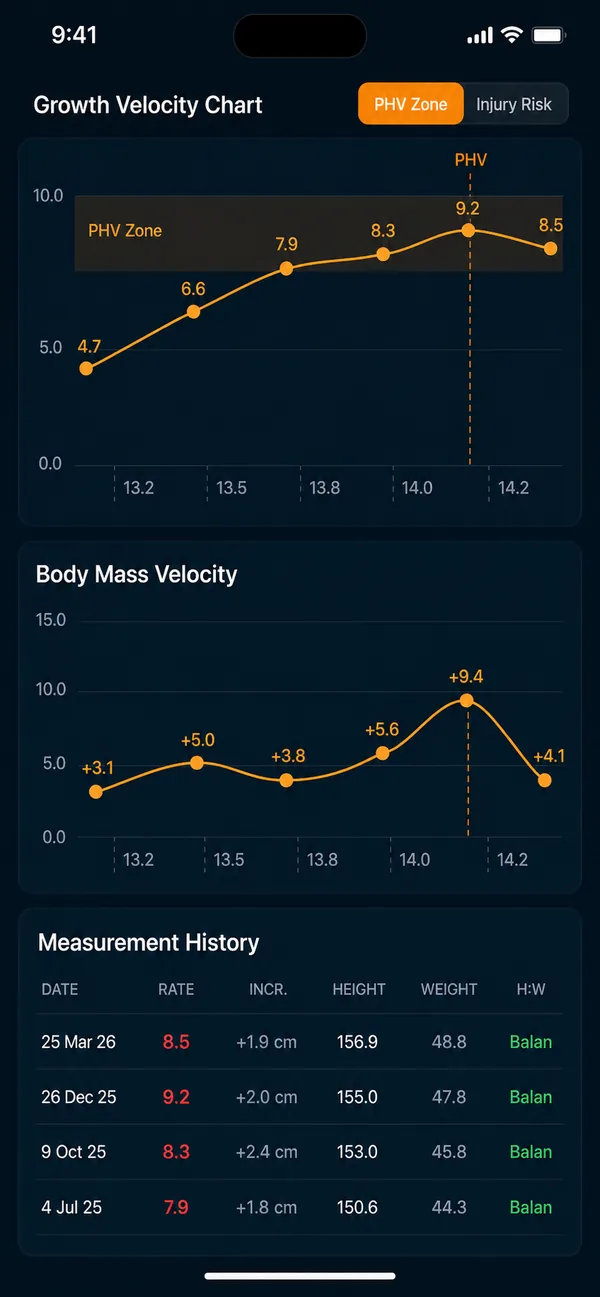
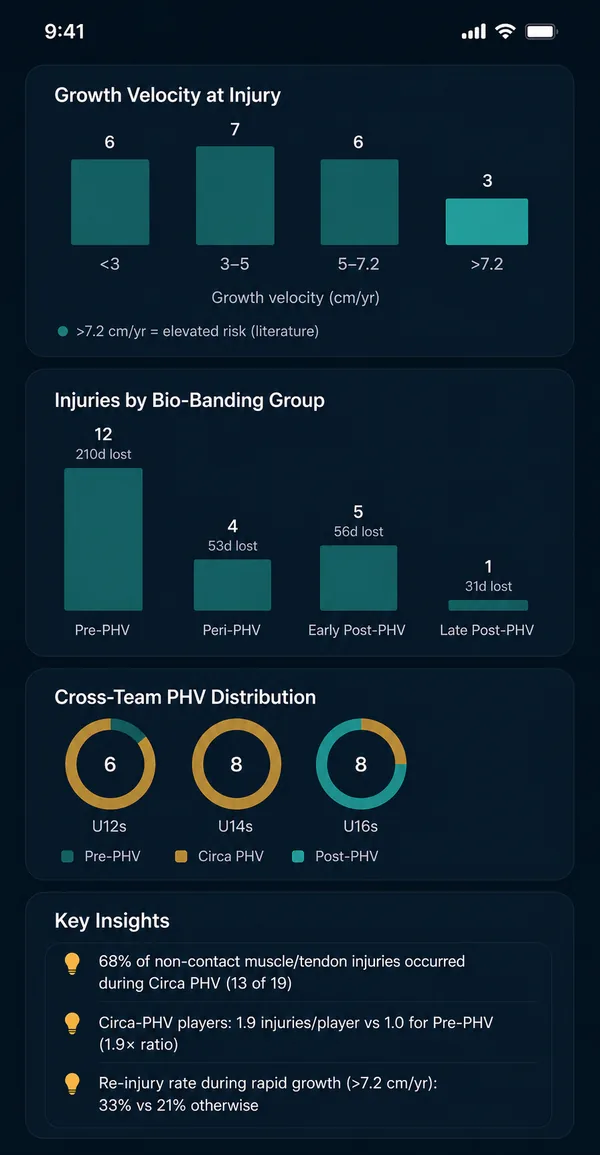
Research in academy football links the period around peak height velocity, the fastest point of the spurt, with more injuries, especially growth-related and overuse injuries.
Johnson et al., 2020 · Rommers et al., 2020Problem 4
The reference method, skeletal age, needs X-rays or specialist equipment. The practical alternatives need careful, regular measurements and spreadsheets, so data usually stays in one person's laptop.
Measuring
iPhone 12 Pro or later (Pro models)
The app checks face, distance, posture and feet to help staff follow a consistent measurement process.
Any iPhone on iOS 17.6+
Type in readings from your stadiometer, tape and scales, or import past seasons.
For reliable estimates
From player to squad
01 / Understand a player
Follow changes in height and body mass as new measurements build a clearer picture of each player’s development.
02 / See the whole squad
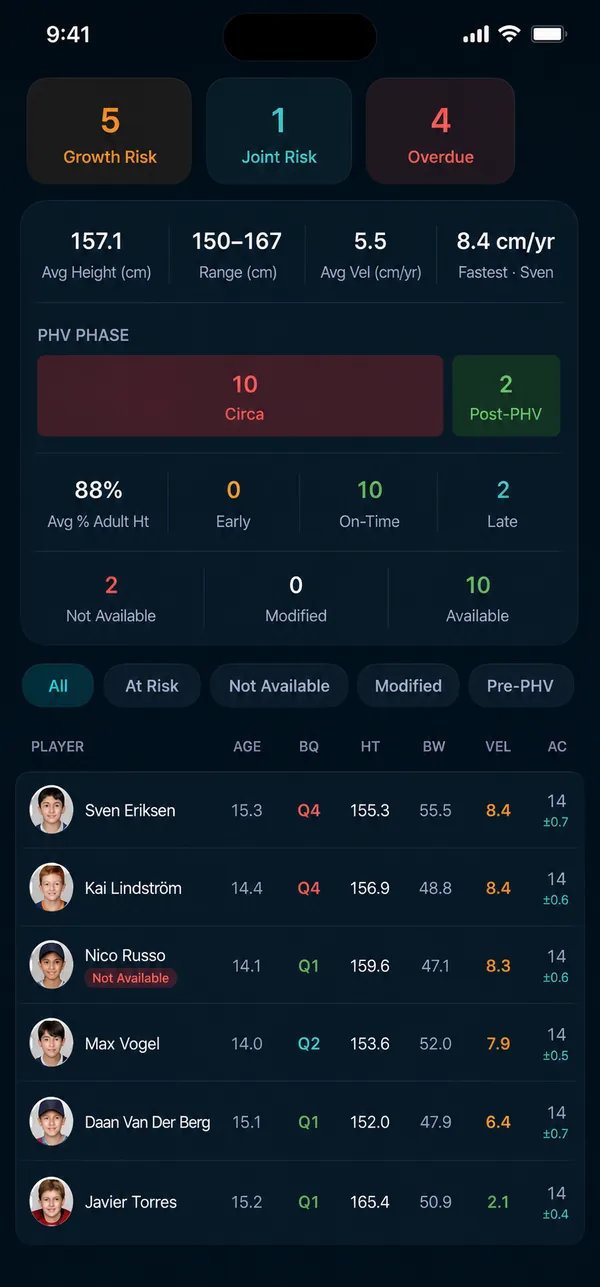
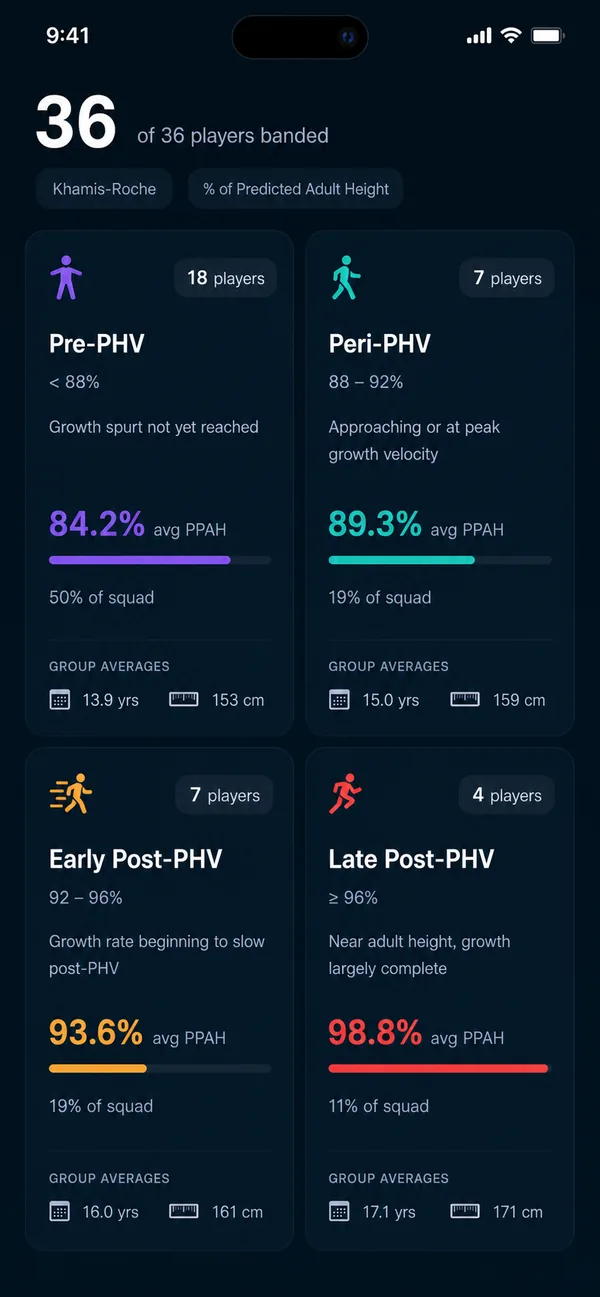
Look beyond age groups to see growth patterns across the squad. Use maturity bands to inform bio-banded sessions and coaching conversations.
03 / Plan by maturity
Use bio-banding alongside age-group training to organise sessions around estimated physical maturity.
04 / Review growth with injuries
Review injury records alongside growth speed and maturity. Give staff a shared view of patterns over time.
These patterns support monitoring and discussion, not individual injury predictions or diagnoses.
The science
Published methods estimate adult height and the timing of maturation. Each estimate shows a range based on the method's published error and typical measurement error.
| Method | Needs | Estimates | Notes |
|---|---|---|---|
| Khamis-Roche | Age, height, body mass and parents' heights | Adult height and % of adult height reached | The most common basis for bio-banding |
| SITAR | At least three heights across a year | Each player's growth curve and adult height | Boys aged 8 to 18 for now |
| Mirwald, Moore and Fransen | Age and height; some also use sitting height and body mass | Time from peak height velocity | No parents' heights needed |
| Visual checks | A coach's or scout's assessment | Early, on time or late | Shown alongside the estimates, as can SonicBone results |
Behind every number, a young athlete.
App users
See development across the whole pathway.
Bring maturity into session planning.
Review injuries alongside growth.
Consider maturity and relative age in selection.
Rosters & staff
01
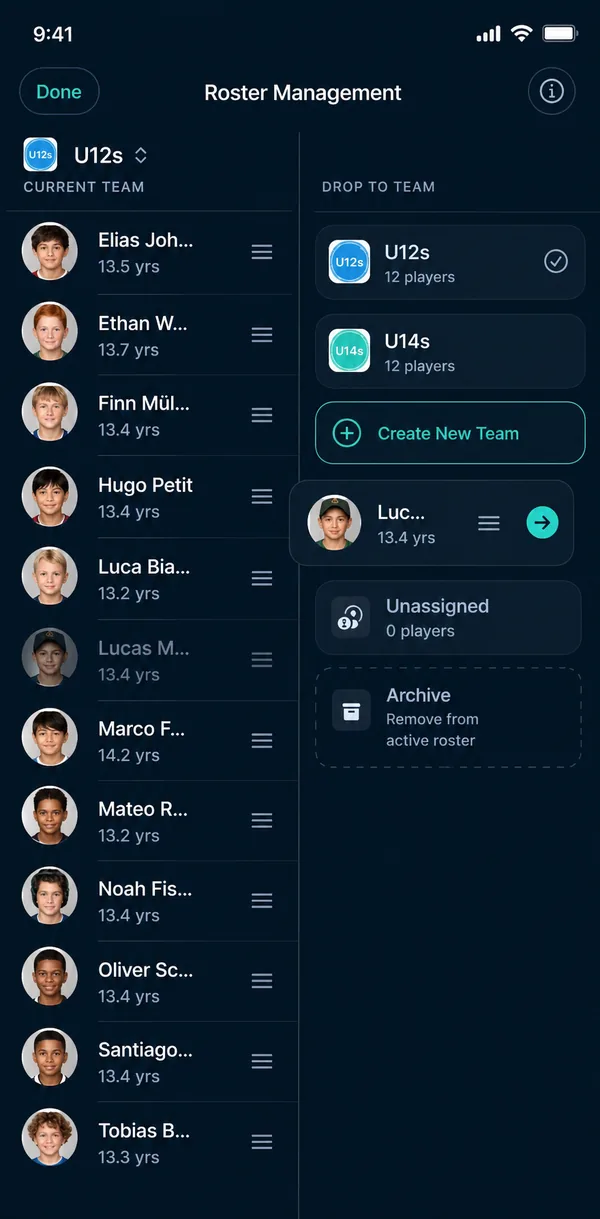
Add players one by one, or import rosters and past measurements from a spreadsheet. Drag players between teams as they move through the pathway.
02
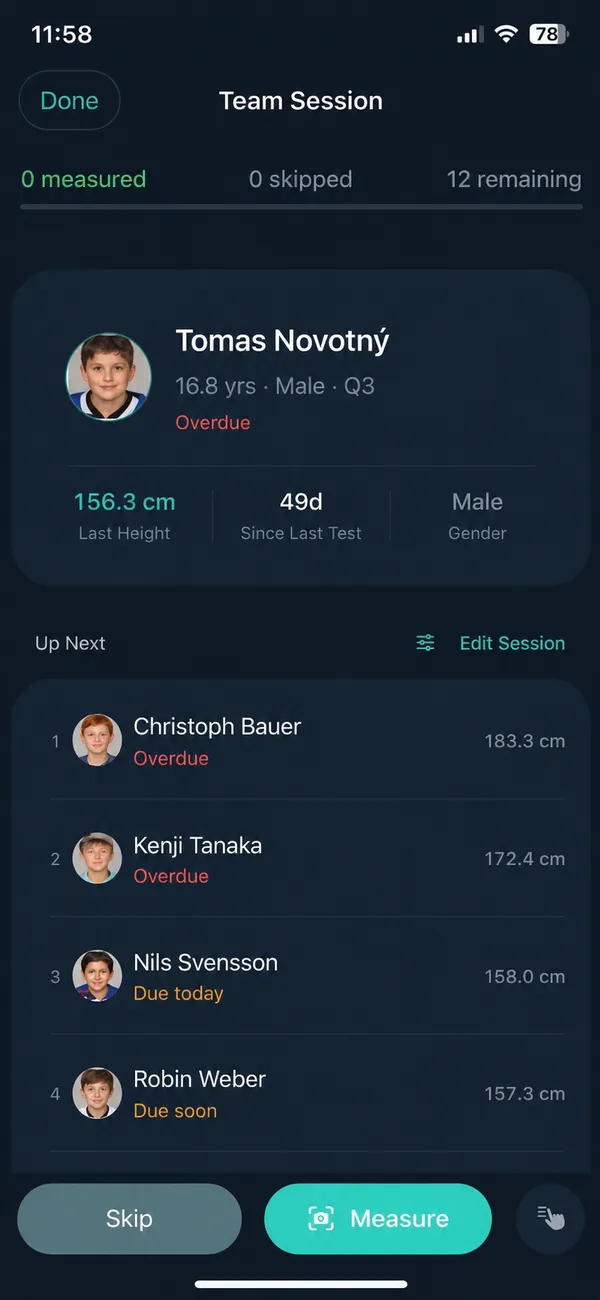
Work through a testing session one player at a time. Each reading lands on the right player.
03
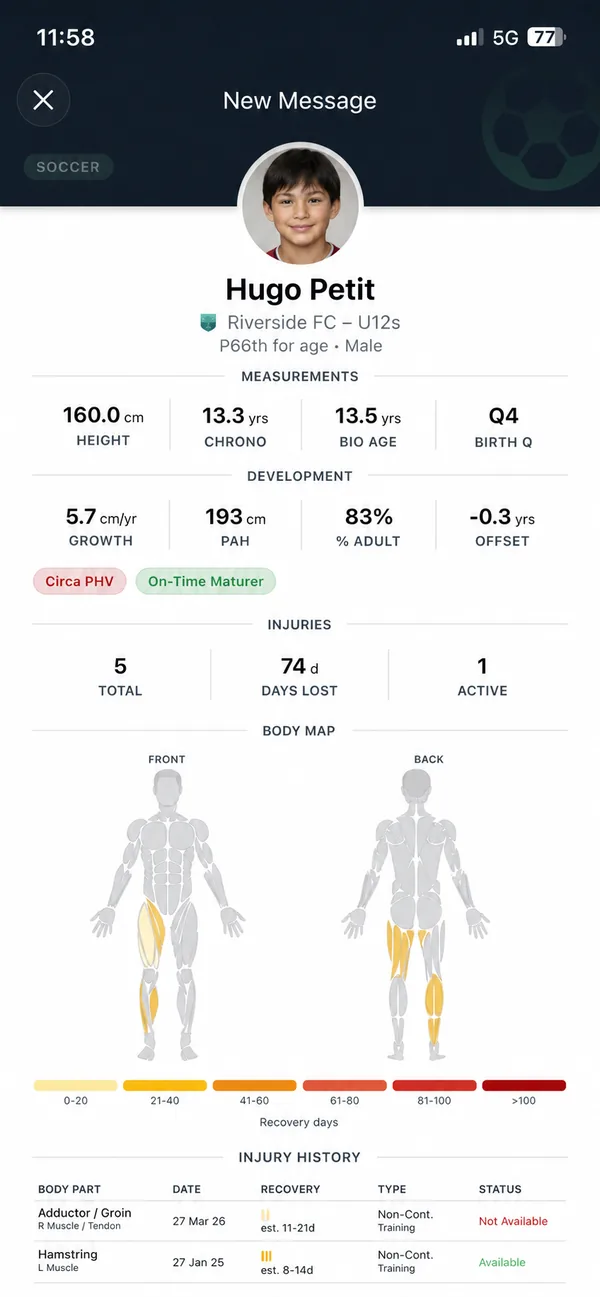
Send results to staff and parents. Present maturity timing as part of normal development, not a verdict on talent.
Data security
Access is set per person, per club and per team, so a U12 coach never sees the U16s unless you say so.
Data is encrypted in transit with TLS and at rest with AES-256, on backend infrastructure covered by a data processing agreement.
Export to CSV whenever you like. Delete a player, or the whole account, and it is gone from our systems within 30 days. Nothing is sold or used for advertising, and model training is opt-in.
Planned launch tiers
A preview of the planned tiers. Final tiers, features and pricing will be confirmed at the official launch.
| Starter5 athletes 1 club · 1 team |
Coach30 athletes 1 club · 3 teams |
Academy500 athletes 5 clubs · 50 teams |
EnterpriseUnlimited athletes and teams |
|
|---|---|---|---|---|
| Camera or manual measurement and height history | ✓ | ✓ | ✓ | ✓ |
| Growth and maturity estimates | ✓ | ✓ | ✓ | ✓ |
| Bio-banding and relative-age reports | ✓ | ✓ | ✓ | ✓ |
| Injury surveillance | ✓ | ✓ | ✓ | ✓ |
| Staff permissions | – | – | ✓ | ✓ |
| Bulk import and CSV export | – | – | ✓ | ✓ |
| SonicBone integration | – | – | ✓ | ✓ |
| Onboarding support for federations and multi-club groups | – | – | – | ✓ |
Tiers, features, limits and pricing will be confirmed at the official launch. Develupp is currently in private beta and is not yet available on the App Store.
FAQ
Still have a question?Email support@develupp.app
Develupp is built on published research used to estimate adult height and maturity timing, the same methods many academies and federations use around the world.
These methods carry their own error, and were validated on specific populations that may not generalise well to others. This is a limit of the current research, and it applies to any tool using these methods.
Data capture, whether by camera or by hand, adds its own measurement error too. Develupp doesn't hide that error: every estimate shows a range based on the method's published error and typical measurement error.
No prediction is ever exact, but understanding the uncertainty around it gives staff the context to use it well.
Bio-banding by % of adult height uses the Khamis-Roche method, so it needs parents' heights. Players without them show as unclassified until you add them.
Maturity offset, an estimate of how far a player is from peak height velocity, uses only the player's own measurements, so you still get it without parents' heights.
Once you have three heights over a year, the SITAR method also activates to predict adult height (boys aged 8 to 18 for now). It just takes a little longer to build.
Visual maturity assessments from coaches and scouts, and SonicBone analysis if your team uses it, can also be imported and analysed alongside everything else available.
Develupp doesn't produce a single injury-risk score. It draws on published research linking growth speed and maturity phase, especially the period around peak height velocity, to higher injury rates in youth academy football (Monasterio et al. 2024, Johnson et al. 2020, Rommers et al. 2020), and follows the IOC's 2020 consensus for recording injury data.
Maturity phase feeds directly into that picture, and you choose which method estimates it, Khamis-Roche, SITAR, Mirwald, Moore or Fransen, depending on what data you have for each player. So you control the inputs behind what Develupp shows.
Treat it as context for a conversation, not a verdict: these signals highlight when to pay closer attention, not who will get injured. Involve a qualified medical professional in any injury decision.
No. Develupp is a sports performance tool, not a medical device. Growth, maturity and injury signals are shown for context, to support conversations between staff, players and guardians, not to diagnose, treat or predict individual outcomes. Any medical decision should involve a qualified professional.
Yes. Most of the published research behind Develupp comes from football, simply because that's where the majority of youth-sport growth and maturation studies have been done. That doesn't limit it to football: the underlying growth and maturity methods aren't sport-specific, and the app recommends which equations suit different populations best.
No. Camera scanning needs a LiDAR sensor, so it requires an iPhone 12 Pro or later, or an iPad Pro (2020) or later. Any other iPhone or iPad on iOS 17.6 or newer can enter measurements by hand, with full access to every report, prediction and injury tool.
Yes. Develupp lets you quickly import rosters and past measurements from XLS, XLSX or CSV files, with downloadable templates that show the expected columns.
If your team uses a SonicBone ultrasound device, a dedicated import brings those results into Develupp too.
If you already have historical data, it's used from the first day.
The in-app setup wizard makes getting your team up and running simple. Follow the steps to create teams and player profiles manually, or import an existing roster, and you can start collecting data within minutes.
Beyond that, our team offers ad-hoc support, and tutorials are being built as we speak.
Not yet. We're building for iOS first.
Android and web are planned for a later release.
Data is encrypted in transit (TLS) and at rest (AES-256), and kept separate per club and per team, so only the staff you approve can see it.
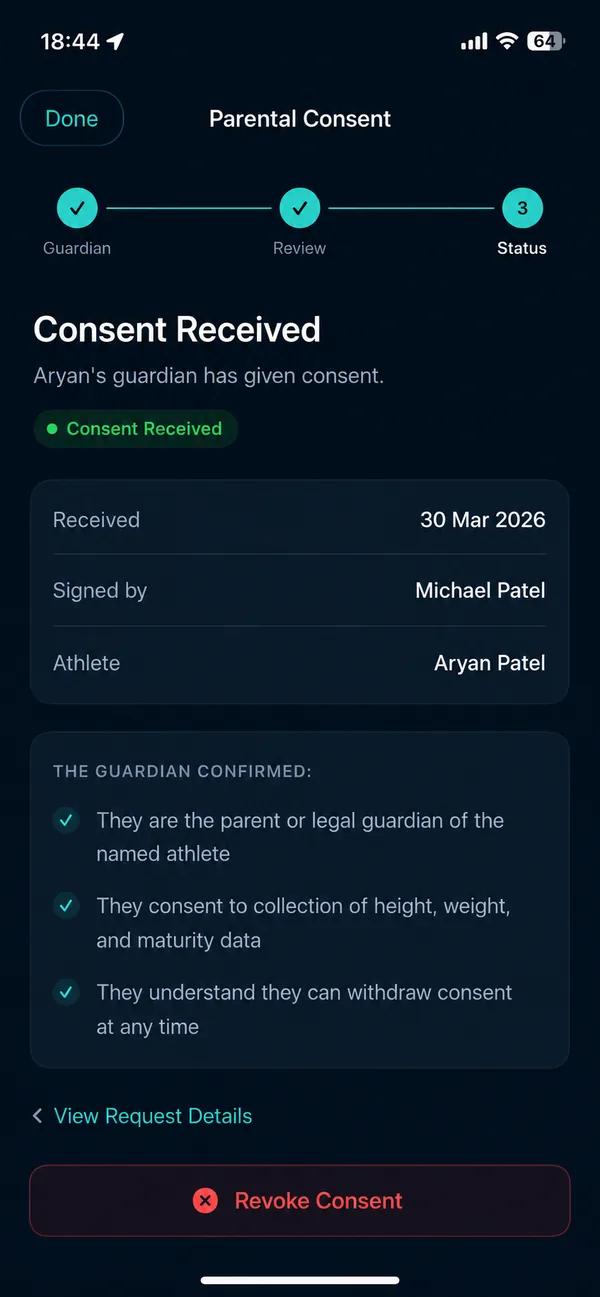
Consent works from inside the app too. Send a guardian a digital request and they can approve it in minutes, straight from the email they receive, no extra paperwork or separate account needed.
We never use your data to train or develop anything without your consent.
You can delete a player, or your whole account, from the app at any time. Deleted data is gone from our systems within 30 days.
We see our beta teams as development partners, not just early users. In return, they'll keep preferential access once Develupp launches publicly, including long-term pricing benefits and extended use privileges.
Private beta · Launch coming soon
Develupp is being tested by selected teams and organisations. We’re inviting a few more before the App Store launch. Access is arranged directly with each team.